

Ajanta and Ellora Caves: History, Art and Essential Travel Tips

0
Table of Contents
You stand at the horseshoe gorge above the Waghora River and understand immediately why monks chose this cliff. The terrain gave them what their practice demanded: isolation so absolute that the world below became theoretical. Across the rock face, 30 caves open at intervals, having outlasted every empire that rose and fell while they were sealed in darkness.
This is your first impression of the Ajanta and Ellora caves in Aurangabad. Not a museum. Not a monument. A place where fifteen centuries of human devotion compressed itself into pigment, stone, and silence, waiting for you to arrive with enough patience to receive it.
Gateway Aurangabad serves as your base. Every Ajanta and Ellora tour should ideally begin here, making your accommodation choice as important as the sites themselves.
Ajanta: Paint That Outlasted Empires
The first Buddhist cave monuments at Ajanta date from the 2nd and 1st centuries BCE. During the Gupta period, many more richly decorated caves were added to the original group. Seven centuries of intermittent creation, each phase separated by generations yet coherent in cumulative effect.
Ajanta constitutes ancient monasteries and worship halls of different Buddhist traditions carved into a 75-metre wall of rock. You move through chambers where light enters at specific angles, illuminating figures mid-gesture: a prince turning toward a supplicant, a dancer caught between movements and a dying man receiving last rites with an attendant's hand resting on his shoulder. These fresco-type paintings depict colourful Buddhist legends and divinities with an exuberance and vitality that is unsurpassed in Indian art.
What stops you isn't their survival across fifteen centuries, remarkable as that is. It's their emotional precision. Grief, compassion, and reverence communicated through posture and gesture with an expressiveness that feels immediate rather than ancient. You find yourself leaning closer, trying to read faces that were painted before the Roman Empire fell.
Plan four to five hours. The caves demand time. The paintings reveal themselves gradually as your eyes adjust to the dim interiors.
Ellora: Three Faiths, One Cliff
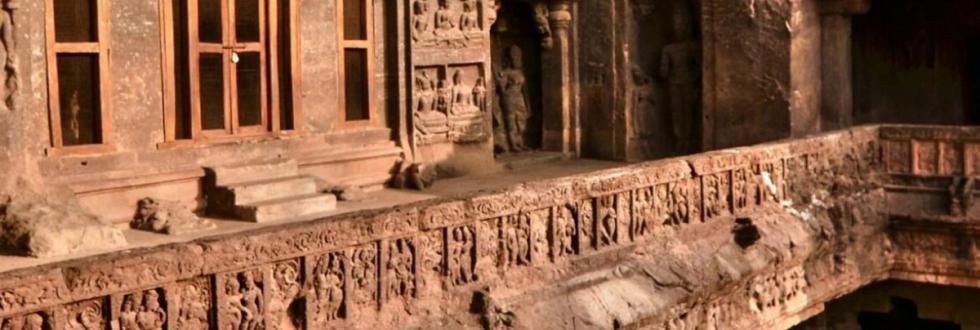
These 34 monasteries and temples, extending over more than 2 km, were dug side by side in the wall of a high basalt cliff. Ellora, with its uninterrupted sequence of monuments dating from 600 to 1000 CE, brings the civilization of ancient India to life.
Buddhist, Hindu, and Jain caves were built in the same cliff face, their proximity a quiet argument for coexistence that requires no translation. You walk from a Buddhist monastery into a Hindu temple into a Jain sanctuary within the same afternoon, each tradition working in the same stone with different vocabulary, different grammar, the same underlying impulse toward the sacred.
The Kailasa Temple at Cave 16 stops you completely. Carved downward from the top of a basalt cliff, an estimated 200,000 tonnes of rock removed over multiple generations to create a freestanding structure that breathes. You circle it slowly, the scale refusing to register all at once, each new angle revealing detail you missed from the previous position. This is the tourist attraction in Aurangabad that renders language inadequate. Plan an hour here alone before continuing through the remaining caves.
Ellora is situated 29 km northwest of Aurangabad, making it the more accessible of the two sites. Three to four hours covers the essential caves thoroughly.
What You Need to Know Before You Go
A visit to Ajanta and Ellora isn’t complicated, but it does require planning. Distances are significant, closing days differ, and both sites demand time on foot. Here’s how to structure your visit properly.
Ajanta Caves
Ajanta sits approximately 100 km from Aurangabad, requiring 2.5 to 3 hours by road. The caves open from 9:00 AM to 5:00 PM and remain closed on Mondays.

Entry fees are ₹40 for Indian nationals and ₹600 for foreign visitors. From the designated parking area, eco-friendly shuttle buses run every 15 minutes to the caves, covering the final 4 km for ₹40 per person.
It’s advisable to book Archaeological Survey of India tickets online in advance. Weekend queues can be long, and waiting in line diminishes the contemplative pace that Ajanta naturally invites.
Ellora Caves
Ellora lies much closer to Aurangabad, about 29 km away, or roughly a 45-minute drive. Visiting hours are 9:00 AM to 5:00 PM, and the site is closed on Tuesdays.
Entry fees are the same as Ajanta: ₹40 for Indian nationals and ₹600 for foreign visitors.
The best time to visit is between October and March, when cooler temperatures make extended exploration comfortable. During these months, morning and afternoon light also enters the cave openings at angles that highlight the carvings with remarkable clarity.
Plan Your Schedule Carefully
Because Ajanta is closed on Mondays and Ellora is closed on Tuesdays, scheduling them on consecutive days simplifies logistics.
Set aside at least two full days to experience both sites without rushing. Each complex requires hours of attentive walking and observation. Attempting to cover both in a single day reduces the experience to a checklist rather than allowing the scale, craftsmanship, and atmosphere to unfold at their intended pace.
Your Base in Aurangabad
Your Ajanta and Ellora tour depends significantly on where you stay. Early departures ensure that you reach the caves before the morning rush. Upon return and after a full day on your feet, you need a base that offers space, privacy, and quiet comfort
At Gateway Aurangabad, set amid landscaped gardens in the heart of the city, you find the kind of restoration that long heritage days demand. You return from the caves to a property designed to replenish rather than simply host. Evenings unfold over dinner at Latitude or The Tea House, where the pace slows and the day softens. The rooms offer space, silence, and deep rest, so you wake ready to begin again.
When your corporate travel in India brings heritage visits together with business commitments, you have access to versatile venues for meetings, conferences, and events within the same property. The concierge arranges your private transfers, coordinates expert guides, and manages the details that ensure your schedule remains seamless rather than strained.
Ellora lies 29 kilometres away, close enough for an easy morning departure. Ajanta, 107 kilometres to the northeast, requires an earlier start and a longer drive. Each evening, you return to one of the finest hotels in Aurangabad’s, where privacy, space, and assured service await.
Arriving Prepared
Choose shoes that are already broken in, as both sites require sustained walking across uneven terrain and stone steps. At Ajanta and Ellora, engage a certified Archaeological Survey of India guide; the murals and carvings unfold in layers of narrative, symbolism, and craftsmanship that are best understood through informed interpretation rather than a cursory walk-through.
Arrive at opening time. The light enters the cave mouths differently at 9 AM than at noon. The silence of early morning at Ajanta, before tour groups fill the gorge with ambient noise, changes the quality of what you receive from the paintings entirely.
Both sites demand full days of attentive walking. Your evenings need to count for something beyond logistics. When you're based at Gateway Aurangabad, your days organize around the caves rather than around hotel schedules.
Gateway Hotels ensures that your experience of the Ajanta and Ellora Caves in Aurangabad reflects their depth, scale, and stillness. Days move at your desired pace, supported by seamless transfers and attentive service that never intrudes. What you carry home is not a rushed itinerary, but a complete and immersive encounter with sites meant to be experienced in full.
Gateway Hotels
Explore unforgettable journeys with Gateway Hotels, your per...
ARTICLE TAGS
COMMENTS
Member? Login here to comment

OUR BRANDS: